
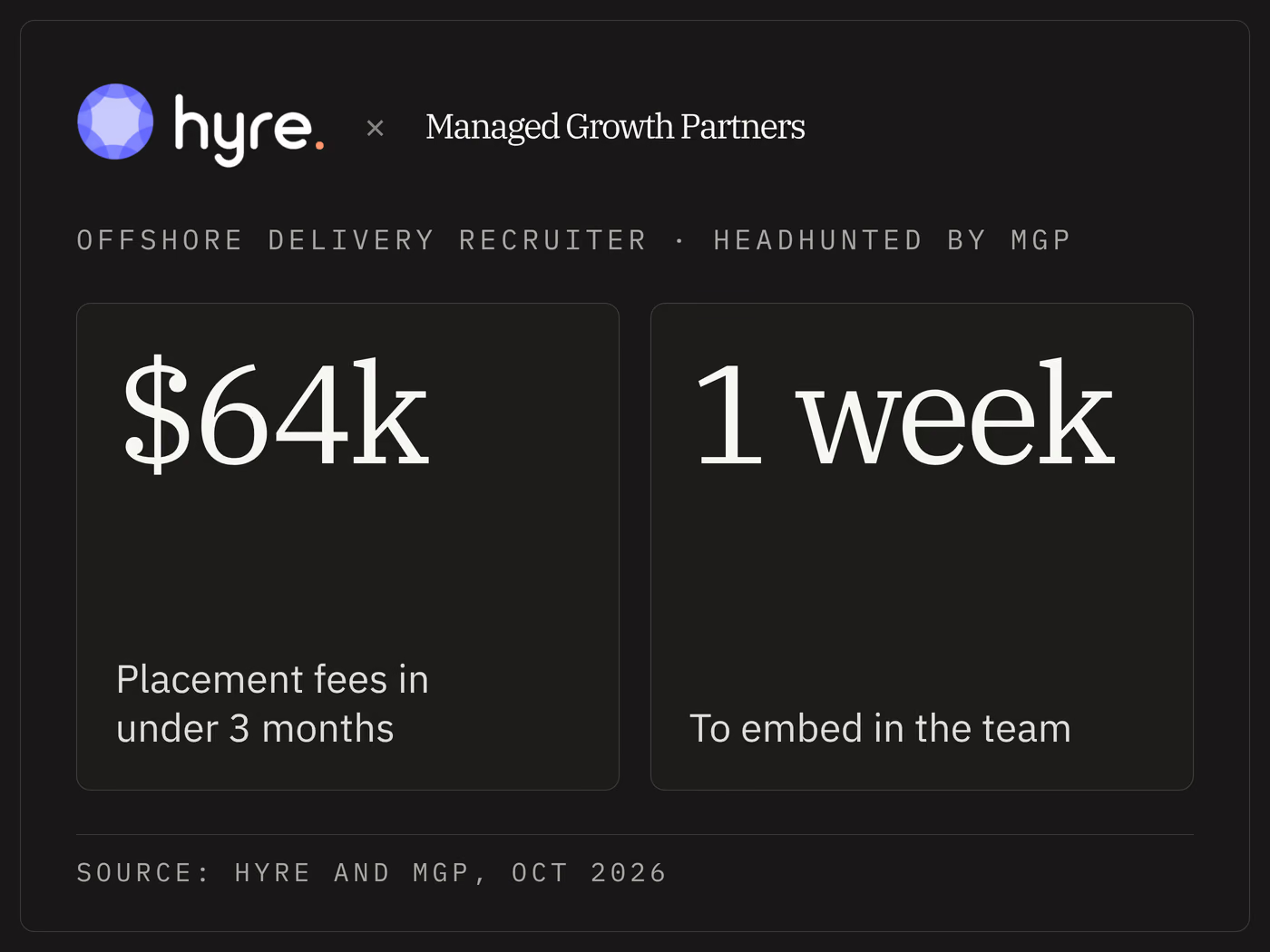
In short: Hyre, a boutique Sydney tech recruitment agency, hired an offshore delivery recruiter through Managed Growth Partners (MGP) in July. In under three months, Dona Eufemio had contributed to about $64,000 in placement fees, with roughly $50,000 more at final stages. Director Jay S. Duc says the bigger win is time: Hyre’s consultants now spend more of it with clients, and delivery quality hasn’t dropped.
Hyre is a boutique tech recruitment agency in Sydney, coming up to its tenth anniversary. It specialises in cloud and infrastructure, trading and regulated finance, working with major banks and financial market operators on one side and data centre businesses building AI compute on the other.
At its largest, Hyre had a team of ten. After the post-COVID swings in hiring, the team shrank right down and has since been rebuilt as a small boutique team. The hard part was always balancing business development with delivery.
It’s very hard to find good recruiters, and it’s hard to find people that are good at both sides. Business development is one very unique set of skills, but delivery is another, and it’s hard to get people that do both.
Jay S. Duc, Director, Hyre
Winning work has also taken more time in recent years, with more client meetings, podcasts, round tables, meetups and conferences. Delivery got pushed into late nights and weekends, and Jay describes the model over the last couple of years as “a bit disjointed”.
This time, Jay designed the model first: a small Sydney team of four or five consultants working closely with clients, backed by offshore delivery specialists who build the candidate pipelines. He also wanted a specialist to run the search. In his view, people in recruitment aren’t necessarily good at recruiting other recruiters.
Jay spoke with MGP for about a month and a half before engaging. MGP explained how the model works, the backgrounds of the people Hyre could access and how other agencies had used it. Hyre ran the numbers internally, then went ahead.
You were just very straightforward with the process, and there was no sales pitch as such. It was just a lot of information about how it works, why it works, who’s doing it and what that success might look like. It was just very consultative.
Jay S. Duc, Director, Hyre
Hyre gave MGP a specific brief, and MGP headhunted against it. The hire was Dona Eufemio, a recruiter in the Philippines whose experience closely matched the brief, including work with Australian stakeholders.
Her background was data and platform engineering at Macquarie Bank, and a large proportion of our clients are within that regulated finance space. So she got what we were doing very early on.
Jay S. Duc, Director, Hyre
Hyre treated Dona as part of the team from day one, not as an outside resource:
Yes, she’s offshore, but she may as well just be sitting next to us.
Jay S. Duc, Director, Hyre
Within a week, Jay says, Dona was embedded in the team and asking for more roles to work on.
In under three months, according to Hyre and MGP:
For Jay, the biggest impact is time. He can now spend five or six hours meeting clients and taking them to lunch, while Dona covers delivery, including a role Hyre is working in Hong Kong.
You’re buying a huge amount of your time back, but you’re also not losing the quality of the delivery.
Jay S. Duc, Director, Hyre
Results like these aren’t typical for every client, and that isn’t down to the talent. Ryan Halson, MGP’s founder, says he can usually tell early which agencies the model will work for: the ones that go in with the right expectations about what the role is for, communicate clearly and trust their people. Hyre did all three.
It’s really important to not consider them as an offshore resource.
Jay S. Duc, Director, Hyre
Jay says he would use MGP again. If Hyre’s business development plan builds enough volume by the end of the first quarter of 2027, he expects to add another offshore delivery specialist. He is also bringing Dona to Sydney for a week to meet the team and join a client lunch, because “the client can see the work, you need to meet the person”. His longer-term model is four or five client consultants supported by two or three delivery specialists.
Managed Growth Partners (MGP) headhunts offshore recruiters against your brief, and we’ll be straight with you about whether the model fits your agency. Book a call to talk it through.